




Break-ins on the Gold Coast are less common than in some parts of Queensland, but they still happen every week; most are opportunistic, and most start at a door or window that was easy to get through. If a break-in in your street, or a post in your local community group, has left you lying awake listening for noises, that feeling is real, and it’s worth taking seriously. The upside is that most of what keeps a home safe is simple, and a lot of it costs nothing.
This guide covers what the numbers actually say, how burglars tend to get in, and what to do if it ever happens to you.
Gold Coast break-ins at a glance
What the Latest Data Says About Break-Ins on the Gold Coast
The most recent regional breakdown from RACQ Insurance, covering claims in 2023, ranked the Gold Coast 10th among Queensland regions for home theft claims, with claims down 17% on the year before. The postcodes with the highest frequency were 4211, 4209 and 4220, which cover areas like Nerang, Coomera and Burleigh.
So the Gold Coast isn’t the hotspot some headlines suggest. But fewer break-ins still means real families dealing with stolen property, damaged doors and a home that suddenly doesn’t feel safe. If you’re one of them, the numbers aren’t much comfort.
Gold Coast home theft claims, RACQ Insurance
2022
116 claims
2023
96 claims
| Measure | Gold Coast, 2023 |
|---|---|
| Rank among 19 Queensland regions | 10th |
| Home theft claims | 96, down from 116 in 2022 |
| Change on the year before | -17% |
| Claim frequency | 0.25% of RACQ home policies |
| Highest-frequency postcodes | 4211, 4209 and 4220 |
Across Queensland, the picture was less rosy
RACQ ranks regions by dividing its home theft claims by the number of RACQ home insurance policies in each area, so it shows how often break-ins happen, not just how many.
How Queensland Compares with the Rest of Australia
According to Australian Bureau of Statistics data, break-ins nationally have eased, but Queensland still stands out for attempted break-ins.
| Measure | Figure | Source |
|---|---|---|
| Australian households with a break-in, 2024-25 | 1.8%, about 196,600 homes | ABS |
| The same figure as the year before, 2023-24 | 2.1% | ABS |
| The same figure ten years earlier, 2014-15 | 2.7% | ABS |
| Queensland households with an attempted break-in, yearly average 2023-25 | About 78,700, the highest of any state | ABS, reported by Finder |
| Victims who reported their latest break-in to police, 2024-25 | 69% | ABS |
Share of Australian households broken into each year
2014-15
2.7%
2022-23
1.8%
2023-24
2.1%
2024-25
1.8%
In other words, the Gold Coast is doing better than many areas, inside a state where people are still having a go at doors and windows more often than anywhere else in the country.
Why Most Break-Ins Are Opportunistic
The Queensland Police Service (QPS) is clear that most break-ins are opportunistic, especially when entry looks quick and easy, and valuables are in sight. Most burglars aren’t planning anything elaborate. They’re walking past and noticing what’s easy.
That’s actually reassuring. It means you don’t have to turn your home into a fortress. You just have to make it harder to get into than the next one.
The Most Common Entry Points Burglars Use
Doors and windows are the usual ways in. Front and back doors are among the most common, along with ground-floor windows and anything left open for airflow. Sliding doors onto the patio and laundry doors at the side of the house are easy to forget, and burglars know it.
Plenty of break-ins don’t involve much force at all. An unlocked door, a window left open while everyone’s out the back, or a key under the pot plant does the job. That’s why QPS recommends keeping doors locked even when you’re home.
| Entry point | Why it gets targeted | What helps |
|---|---|---|
| Front and back doors | The most common way in | A security door, locked even when you’re home |
| Ground-floor windows | Easy to reach and often left open | Security window screens |
| Patio sliding doors | Large, often open for airflow | A sliding security door with a heavy-duty interlock |
| Laundry and side doors | Out of sight and easy to forget | A security door and a locked side gate |
| A spare key outside | No force needed at all | Keep spare keys with someone you trust |
Indoor-Outdoor Living and the Open Door Problem
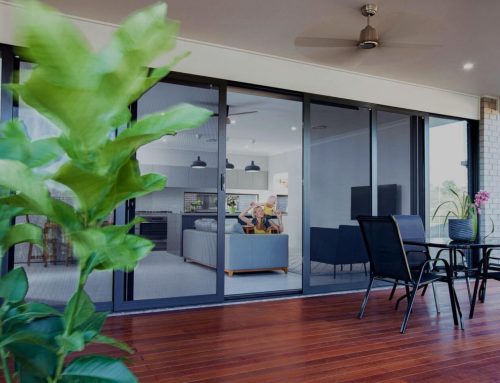
We live with the doors open here. Summer’s humid, the breeze is the best air conditioning there is, and nobody wants to shut the house up just to feel safe.
The trouble is that a standard flyscreen keeps insects out and nothing else. It can be cut or pushed through in seconds. A proper security screen lets you keep the glass open and the air moving while the door itself stays locked, so you don’t have to choose between comfort and security.
| Standard flyscreen | Crimsafe security screen | |
|---|---|---|
| Keeps insects out | Yes | Yes |
| Lets the breeze through | Yes | Yes |
| Stops someone cutting through | No, it can be cut in seconds | Passes the knife shear test |
| Stops someone pushing through | No | Stainless steel mesh clamped into the frame |
| Safe to leave the glass open | No | Yes, with the screen locked |
Holiday Periods and Homes Left Empty
Christmas and school holidays leave plenty of Gold Coast homes empty, and empty homes give themselves away. QPS points to things like curtains closed during the day and mail piling up as signs nobody’s home. RACQ’s 2023 claims data also had January to March as the busiest quarter for home theft.
Physical Barriers vs Cameras and Alarms
Cameras and alarms both have a place. A camera records what happened, and an alarm tells you or a monitoring service that something’s happening. Neither stops someone at the door.
A security screen does. It’s a physical barrier at the point of entry. A study by the Australian Institute of Criminology, which interviewed burglars in Western Australia, found security screens were among the things offenders said put them off, along with dogs and alarms. We see screens as the foundation and cameras as a smart extra, not the other way round.
| Security screens | Alarms | Cameras | |
|---|---|---|---|
| What it does | Physically blocks the way in | Alerts you or a monitoring service | Records what happened |
| Stops someone at the door | Yes | No | No |
| Puts burglars off | Yes | Yes | Can help |
| Lets you leave the glass open | Yes | No | No |
| Best used as | The foundation | A smart extra | A smart extra |
What Makes a Security Screen a Genuine Security Product
Not everything sold as a security door is one. In Australia, security screen doors and windows are tested against standards including AS5039. Products that don’t meet the standard are barrier screens or flyscreens, however solid they look.
The tests a genuine security screen has to pass
| Test | What it checks |
|---|---|
| Knife shear | Whether a heavy-duty knife can make a cut longer than 150mm in the mesh |
| Impact | Whether the screen holds when something heavy is swung into it |
| Jemmy | Whether a lever can force the locks, fastenings or hinges |
| Pull | Whether the mesh can be pulled out of the frame |
| Probe and shear | Whether tools can get through or cut the strands |
Layering Your Home Security for Real Protection
QPS suggests working from the outside in. Each layer makes your home a little harder to get into than the one next door.
What to Do in the First Hours After a Break-In
If you come home to find your place has been broken into:
Fast-Track Help for Gold Coast Homes After a Break-In
Waiting weeks with a damaged door is the last thing anyone needs after a break-in, so we offer a fast-track service.
Flat $99 callout where there’s been an attempted break-in or vandalism.
What happens when you call us
If you’re replacing damaged screens or starting fresh, the final price depends on the range, the size of each opening, what the installation involves, and the frame colour. As a guide:
Don’t Wait for It to Be Your Street
Most people call us after a break-in, theirs or a neighbour’s. You don’t have to wait for that. Securelux has been in the security screen industry for over 40 years. We’re a Crimsafe Authorised Licensee, an NSSA member, and QBCC licensed (1187294), and we cover the Gold Coast down to Burleigh as well as Brisbane, Ipswich and Moreton Bay.
Book a free consultation, and we’ll walk through your home with you, point out the weak spots, and give you a quote held for 30 days. If someone in your street has just been broken into, send them this page. The checklist above is worth having handy.
Break-Ins on the Gold Coast: FAQs
Figures are from RACQ Insurance, the ABS, the Australian Institute of Criminology and the Queensland Police Service, current at the time of writing.



Leave A Comment