



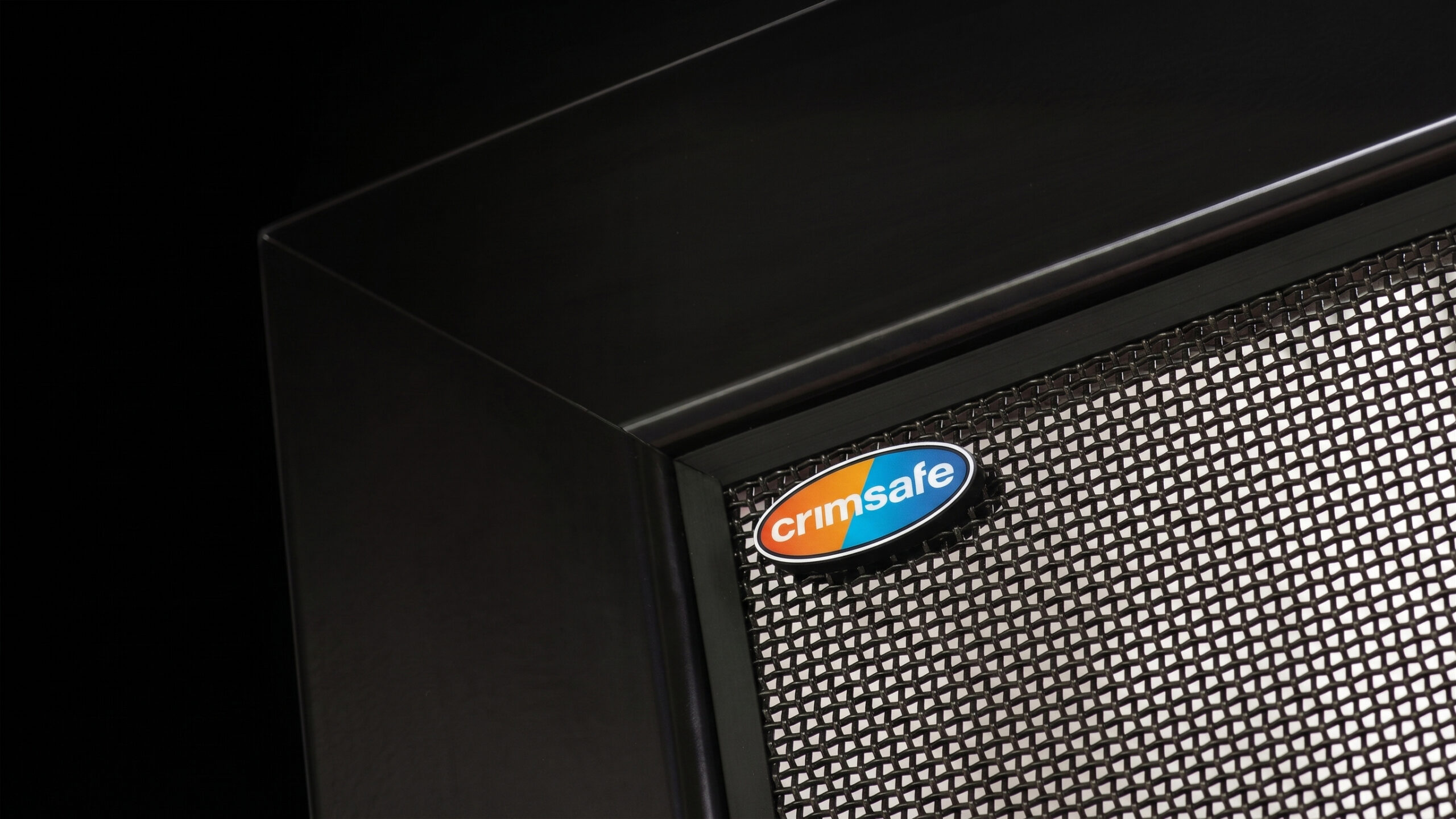
The knife shear test is an Australian Standard test that checks whether an intruder can slash a security screen open with a utility knife, and a screen passes if the blade cannot cut an opening longer than 150mm. Crimsafe says its 0.9mm Tensile-Tuff stainless steel mesh easily outperforms that requirement. If your old flyscreen or barrier door is torn, rattly, or could be opened with a box cutter in seconds, this is the test that separates real security from something that only keeps the mozzies out.
Most people never hear about the knife shear test until after someone has tried it on their screen. It’s worth knowing how it works before then.
The quick answer
- What it tests: whether a heavy-duty knife can slash an opening in the screen’s mesh.
- How it’s done: three strikes, with a new blade for each one.
- What counts as a pass: no cut longer than 150mm.
- Why Crimsafe resists it: thick 0.9mm Tensile-Tuff stainless steel mesh, held in the frame by the Screw-Clamp system.
150mm
Longest cut allowed for a pass
3
Strikes, each with a fresh blade
0.9mm
Tensile-Tuff wire in Crimsafe Regular and Ultimate
26.5%
Thicker than typical stainless security mesh
Why Cutting the Mesh Is a Common Break-In Method

A standard flyscreen uses fibreglass or light aluminium mesh. It’s built for insects, not people, and a sharp blade goes through it with almost no effort or noise. For an opportunistic intruder, slicing a flyscreen to reach a latch or an open window is quick, quiet, and needs nothing more than a pocket knife.
Break-ins commonly happen through doors and windows, and a 2020 industry white paper from Alspec estimated that roughly 200,000 Australian homes are broken into each year. That’s why any product sold as a security screen should be able to stand up to a knife, not just a kick.
A lot of doors sold as “security doors” are really barrier doors with a sturdier frame and a decorative grille. If the infill can be cut, the strength of the frame doesn’t help much. We cover this in more detail in the limitations of standard security screens.
| Screen type | Infill | Built for | Against a blade |
|---|---|---|---|
| Flyscreen | Fibreglass or light aluminium mesh | Insects | Cuts easily and quietly |
| Barrier door | Insect mesh behind a decorative grille | Insects and a visible deterrent | Mesh can be cut to reach the lock |
| Crimsafe Regular and Ultimate | 0.9mm Tensile-Tuff 304 stainless steel mesh | Intruders and insects | Crimsafe says it easily outperforms the knife shear test |
Where the Knife Shear Test Sits in the Australian Standards
Three Australian Standards have traditionally worked together for security screens:
| Standard | What it covers |
|---|---|
| AS 5039 | Performance requirements for security screen doors and window grilles |
| AS 5040 | Installation |
| AS 5041 | Test methods, including the knife shear test |
AS 5039 was revised in 2023, and the installation requirements have since moved into AS 5039.2:2024, which superseded AS 5040-2003. Whichever edition a supplier quotes, the knife shear test is one of six forced-entry tests used to show a product’s performance: dynamic impact, jemmy, pull, probe, shear and knife shear.
How the Knife Shear Test Is Carried Out Step by Step
The test copies what an intruder with a utility knife would actually do, just in a lab instead of on your back porch.
Step 1
Blade meets mesh
A heavy-duty knife blade is forced across the screen’s infill to simulate a slashing attack.
Step 2
Three strikes, new blade each time
The test is carried out three times, with a fresh blade for every strike so it’s always at its sharpest.
Step 3
Measure the damage
Testers check whether the blade has cut an opening in the mesh, and how long it is.
The exact force, angle and set-up are defined in the Standard and carried out by a testing laboratory.
What Counts as a Pass: The 150mm Limit
A screen passes the knife shear test if the blade cannot make a cut longer than 150mm. That limit matters because 150mm is roughly enough room to get a hand through and reach a lock or latch.
Pass
Across all three strikes, no cut in the mesh is longer than 150mm.
Fail
The blade makes a cut longer than 150mm, enough for a hand to reach through to the lock.
A screen either holds below that limit or it doesn’t. There’s no “nearly passed”.
Keep in mind what the test doesn’t measure. The knife shear test looks at the infill, meaning the mesh. It doesn’t tell you how well the lock, hinges or frame hold up. That’s why it sits alongside the other tests rather than standing on its own, and why you should look at the full set of results when you compare products.
How 0.9mm Tensile-Tuff Mesh Resists a Blade
Crimsafe credits its result to the mesh itself. Crimsafe Regular and Ultimate use 0.9mm Tensile-Tuff mesh made from 304-grade high-tensile structural stainless steel, which Crimsafe says is 26.5% thicker than typical stainless steel security mesh. Crimsafe also says only its 0.9mm Tensile-Tuff mesh exceeds the Australian Standard knife shear test.
A thicker, harder wire is much harder for a blade to bite into. Instead of slicing through, the knife tends to skate across the surface or blunt quickly. It still looks like fine mesh from inside your living room, so you keep your view and your breeze, but it behaves very differently when someone takes a knife to it. For a closer look, see our article Is Crimsafe cut safe?
Crimsafe First uses a 0.8mm stainless steel mesh and is tested to impacts of up to 400 joules, giving budget-conscious homeowners an entry point into the range.
How Screw-Clamp Technology Keeps the Mesh in the Frame Under Attack
Cutting is only one way in. If an intruder can’t slice the mesh, the next move is often to pull or pry it out of the frame.
That’s where Crimsafe’s Screw-Clamp system comes in. The mesh is clamped into the aluminium frame and secured with tamper-resistant stainless steel screws, rather than glued in or pressed in with a plastic wedge. Any force on the mesh spreads out around the frame instead of tearing it free at one weak spot. On Ultimate, there are twice as many screws as on Regular, for an even tighter grip.
Why the Angle of Attack Matters

Intruders don’t always cut the same way. A screen that resists a horizontal slash but gives way to a diagonal one isn’t much comfort at two in the morning. Woven stainless steel mesh has wire running in both directions, so a blade meets the same tough wire whichever way it’s drawn. When you compare products, it’s worth asking how the infill copes with cuts from different angles, not just the one shown in a sales video.
The Other Forced-Entry Tests: Impact, Jemmy, Pull, Probe and Shear
A screen that can’t be cut can still be kicked, pried or pulled. Here’s how the full set of tests works:
| Test | What it simulates | How it works | Crimsafe result |
|---|---|---|---|
| Knife shear | Slashing the mesh with a knife | Three strikes, new blade each time, no cut over 150mm | Easily outperforms the Standard |
| Dynamic impact | Kicks, punches and shoulder charges | Five impacts of 100 joules | Regular: single impact of 550 joules. Ultimate: 750 joules |
| Jemmy | Prying at lock and hinge points | Fails if a component fails or the gap to the frame exceeds 15mm | Designed to meet the Standard in every section |
| Pull | Pulling the mesh out of the frame | Carried out if a large enough gap is created to grip | Screw-Clamp grips the mesh along the whole frame |
| Probe | Pushing a tool through to reach the lock | A deflecting force of 150kg is applied to try to open a gap | Fine mesh apertures of about 1.5mm |
| Shear | Cutting individual strands with pliers | Applied where the aperture is wide enough to reach a strand | 0.9mm high-tensile stainless steel wire |
On impact, the gap between the Standard and Crimsafe’s published single-impact ratings is easy to see:
Australian Standard impact test
Crimsafe First
Crimsafe Regular
Crimsafe Ultimate
Crimsafe also notes that University of Queensland testing found Crimsafe outperforms competitor screens.
Why a Tested Screen Still Depends on Correct Installation
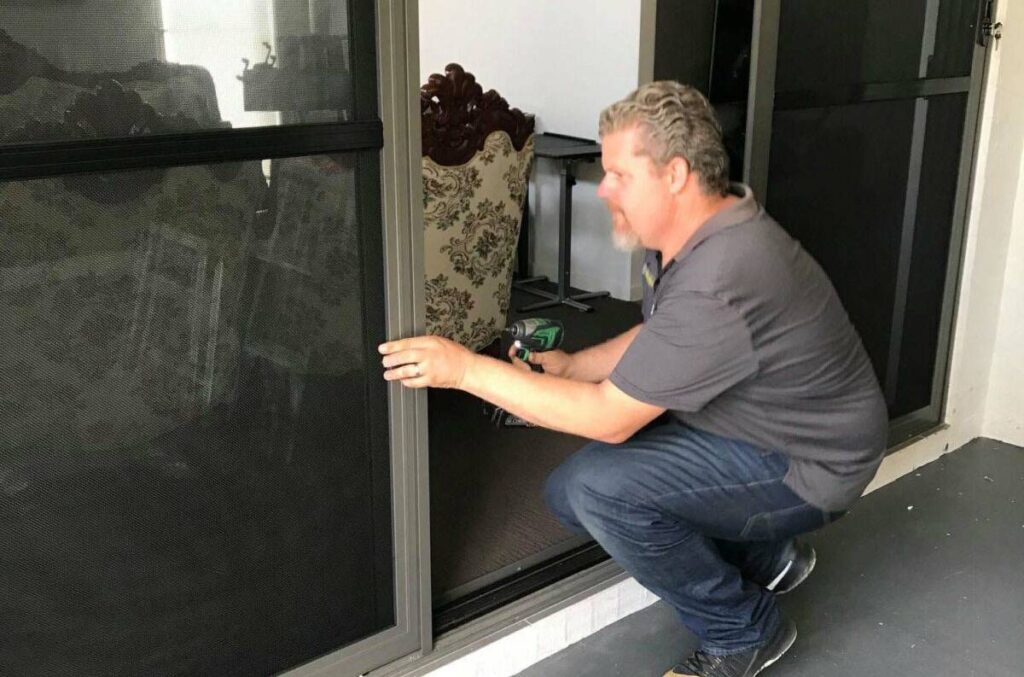
Sales brochures tend to skip over this. Every one of those test results was achieved on a screen fitted correctly. A screen that’s badly measured, fixed into a weak frame, or fitted outside the installation Standard can fail in ways the lab never saw.
That’s why at Securelux:
- Our installers are our own employees, not subcontractors
- We use heavy-duty accessories on every installation
- Every sliding door we install gets our interlocking system and an Austral triple lock
- We’re QBCC licensed (Licence No. 1187294) and comply with all QBCC standards
How to Check a Security Screen Is Genuinely Compliant
Before you accept a quote, run through this checklist:
- Ask for proof of compliance with AS 5039, such as test documentation or a compliance label.
- Ask for written confirmation that installation will comply with the current installation Standard.
- Confirm the business is a Crimsafe Authorised Licensee on Crimsafe’s supplier finder, if you’re being quoted Crimsafe.
- Check the QBCC licence number on the QBCC online licence search.
- Ask whether the business is an NSSA member.
The National Security Screen Association provides education, training and accreditation to its members. Securelux is both a Crimsafe Authorised Licensee and an NSSA member.
What the Knife Shear Test Means for Your Home
For you, the knife shear test means this: the screen on your back door can stay locked while the door behind it is open, and a blade won’t get someone inside. That’s what makes it possible to catch the evening breeze, let the dog wander in and out, and still feel safe.
It also means you don’t have to choose between security and the way you like to live. Crimsafe says its Tensile-Tuff mesh blocks up to 53% of solar heat gain and up to 62% of UV rays, so the same screen that stands up to a blade also helps take the edge off a hot Queensland afternoon. For families heading away on holidays, knowing the screens have been independently tested makes it a lot easier to lock up and leave.
Knife Shear Test: Frequently Asked Questions
What is the knife shear test?
It’s one of the Australian Standard forced-entry tests for security screens. A heavy-duty knife is forced across the mesh three times, with a new blade for each strike, and the screen passes if no cut is longer than 150mm.
Can Crimsafe be cut with a knife?
Crimsafe says its 0.9mm Tensile-Tuff mesh, used in Regular and Ultimate, easily outperforms the Australian Standard knife shear test. A blade tends to skate across the thick stainless wire or blunt quickly rather than slicing through.
Why is the limit 150mm?
A cut of around 150mm is roughly enough room to get a hand through and reach a lock or latch, so the Standard sets that as the line between a pass and a fail.
Does passing the knife shear test make a screen secure on its own?
No. The test only checks the mesh. A secure screen also needs to pass impact, jemmy, pull, probe and shear testing, and it needs to be installed correctly.
Will a flyscreen or barrier door pass the knife shear test?
A standard flyscreen is built to keep insects out and cuts easily with a blade. Many barrier doors use similar insect mesh behind a grille, so the mesh can still be cut to reach the lock.
Can I see Crimsafe mesh before I buy?
Yes. Our consultants bring samples to every free consultation, so you can see and feel the mesh up close. Call 1300 11 51 51 to book.
See the mesh up close
We’ve been helping Brisbane, Gold Coast and Redlands families feel safe for over 40 years, with a 4.9-star Google rating. Our consultants bring samples to every free consultation.
And if a friend has just had their flyscreen slashed, send this their way.



Leave A Comment