

Coastal & Cyclone:
The 304 Vs 316 Debate
Security Screens for Coastal Queensland: What Should You Choose?
If you live near the coast in Queensland – whether that is the Gold Coast, Moreton Bay, Redlands, or anywhere within sight or smell of the ocean – you have probably come across the 304 vs 316 stainless steel mesh debate. It is one of the most searched and discussed topics in the security screen industry, and it is where a lot of misinformation circulates. Here is the factual, practical breakdown from Securelux.
Understanding the Grades
304 Structural-Grade Stainless Steel
304 stainless steel contains approximately 18% chromium and 8% nickel. It offers good general corrosion resistance and is widely used across construction, food processing, and manufacturing. Critically for security screens, 304 structural-grade steel has a higher tensile strength than 316, meaning it resists stretching and cutting better under impact. This is why Crimsafe uses 304 for its Tensile-Tuff mesh – it allows for superior impact performance in security testing.
The trade-off: 304 stainless steel is more susceptible to pitting corrosion in chloride-rich environments (like salt air) than 316. On its own, raw 304 mesh would not be the ideal choice for a beachfront home.
316 Marine-Grade Stainless Steel
316 stainless steel adds approximately 2–3% molybdenum, which significantly improves resistance to pitting and crevice corrosion in the presence of chloride ions. This is why it is called “marine grade” and is the standard for boat fittings, coastal railings, and ocean-exposed hardware. Most Crimsafe competitors use 316-grade mesh.
The trade-off: 316 mesh is typically thinner (0.8 mm) and has lower tensile strength than Crimsafe’s 304 mesh (0.9 mm). It passes Australian standard testing but does not achieve the same impact absorption results. And 316 is not immune to corrosion – it still requires maintenance in harsh coastal conditions.
How Crimsafe Bridges the Gap
Crimsafe does not rely on the raw corrosion resistance of 304 stainless steel alone. The system uses multiple layers of protection:
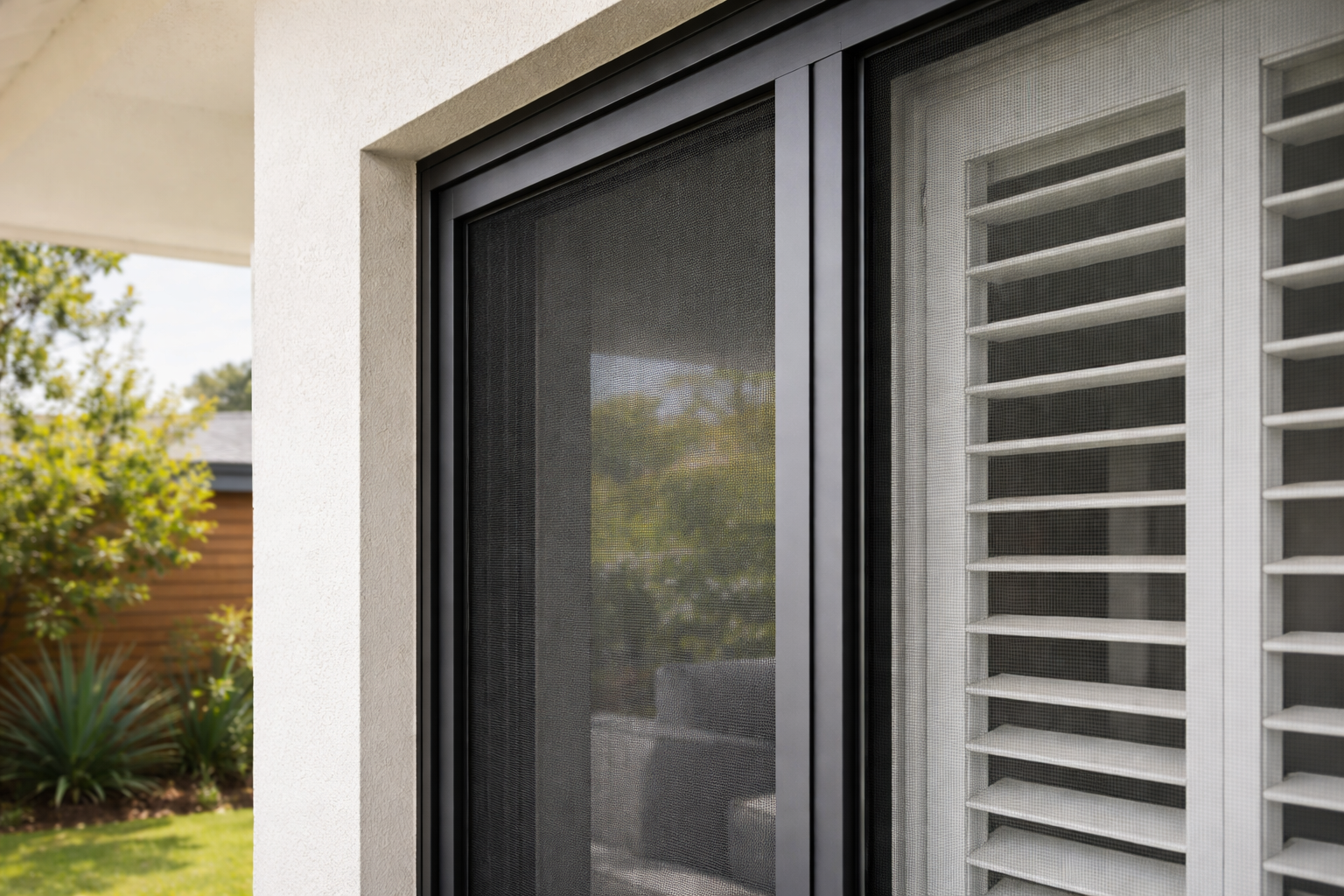
Crimsafe has passed the Australian Standard Salt Spray Test (AS 2331.3.1) at 3,000 hours – three times the standard benchmark of 1,000 hours – with no corrosion. It also passes the Prohesion Accelerated Test (ASTM G85), which more closely replicates real-world outdoor exposure.
Securelux Recommendations by Distance to Coast
| Distance from Coast | Corrosion Risk | Securelux Recommendation |
|---|---|---|
| More than 10 km | Low – general humidity and occasional storms | Standard Crimsafe with Securelux factory corrosion protection. Standard maintenance (rinse every 3–6 months). |
| 2–10 km | Moderate – airborne salt, higher humidity | Crimsafe with standard protection. Monthly rinse recommended. Consider 3M security film on exposed glass for layered protection in storm season. |
| Under 2 km (direct coastal) | High – regular salt spray, coastal wind | Crimsafe with full corrosion package. Fortnightly to monthly freshwater rinse essential. Discuss specific exposure at consultation. Layer with 3M film for glass protection. |
| Direct beachfront / salt spray zone | Very high – persistent chloride exposure | Detailed site assessment required. Securelux will discuss the specific exposure, prevailing winds, and whether additional protection or alternative solutions are appropriate. Strict maintenance schedule agreed at consultation. |
Maintenance Is the Real Variable
Here is the honest truth that often gets lost in the 304 vs 316 debate: the most important factor in how well any stainless steel screen holds up on the coast is maintenance. A 316 mesh screen that is never rinsed will corrode. A 304 Crimsafe screen that is rinsed regularly will last for many years without issue.
The maintenance requirement for coastal Crimsafe is simple: rinse with clean freshwater regularly (monthly or fortnightly in high-exposure areas), keep tracks clear of salt build-up, lubricate locks and rollers annually, and avoid abrasive cleaners.
Coastal + Cyclone: Layered Protection
For homes in cyclone-rated areas of coastal Queensland, Securelux recommends a layered approach: Crimsafe screens on doors and windows for impact, security, and debris protection, combined with 3M security film on glass for shatter resistance and UV reduction. Together, these create a comprehensive barrier against forced entry, storm damage, and everyday wear from harsh coastal conditions.
Securelux does not dodge the 304 vs 316 question. The answer is nuanced: 304 with proper protection and maintenance performs very well for the vast majority of Queensland coastal homes. For extreme exposure, we discuss the specifics with you directly.
Book a free coastal consultation on 1300 11 51 51.